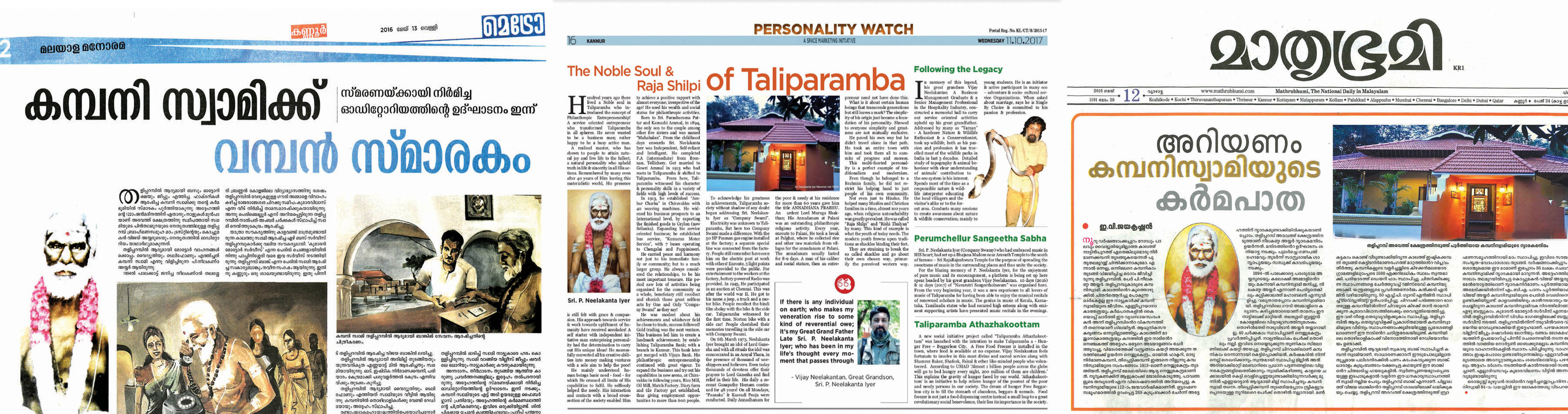
What is it about certain human beings that transcends generations but still leaves a mark? I have wondered about it many times. What provoked the thoughts first in my mind? Was it Gandhi? No. Was it Vivekananda? No. Though these personalities did inspire the question later on. But for me, it began with someone called Company Swami. He is Sri. Neelakanta Iyer, reverently and lovingly called company swamy by those whose lives he touched. He hails from a small town of Taliparamba in Kerala. By all accounts, he was born to a very simple Brahmin family. But the simplicity of his origin just became a foundation of his personality. His life was anything but. Goes to show everyone simplicity and greatness are not mutually exclusive. He paved his own way but he didn’t travel alone in that path. He took an entire town with him and took them all to summits of progress and success. Who was he? Let’s meet him. Neelakanta Iyer – The Brahmin This multi-faceted personality is a perfect example of traditionalism and modernism. Yes, that is not an oxymoron. He proved that they can go hand in hand. His life is a study of how you can be rooted in your traditions, respect your religious beliefs and still embrace progress. Every day of his life, regardless of his surroundings, he performed “Nithya Ganapathi Homam”. He lived by his principles and led by example of how a Brahmin should lead his life. He lived a simple life, like a saint. He followed the concept of “Unchu vrutthi”, which means collecting rice and other raw materials from villagers. A man of his caliber and social stature, then an entrepreneur need not have done this. Even though he belonged to a Brahmin family, he did not restrict his helping hand to just people of his own community. Not even just to Hindus. He helped many Muslim and Christian families in a time, almost 100 years ago, when religious untouchability was greatly prevalent. He consecrated “Kubera Ganapathy” idol at Arayal thara in Taliparamba. He was called “Raja Shilpi” and “Rishi Thulyan” by many. This kind of example is what the youth of today needs. The modern youth frowns upon traditions as shackles binding their feet. They are straining to break the so called shackles and go about their own chosen way, primarily the perceived western way.
 Sunitha Bharathan
Back to articles
Sunitha Bharathan
Back to articles


